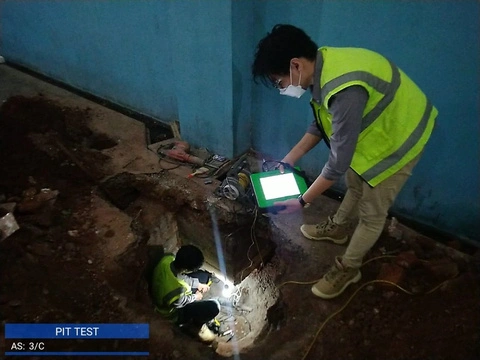
FOUNDATION TESTING
Foundation testing is conducted to ensure physical integrity and load-bearing capacity of driven or bored piles before building structures are erected.
Foundation Testing
Geotechnical & Foundation Services
Professional and accurate integrity and load capacity testing for foundation piles, fully compliant with construction technical specifications.
Objective:
- Inspect continuity and integrity of the pile along the testable depth.
- Identify indications of damage such as cracks, necking, cross-sectional changes, or non-homogeneous material.
- Ensure pile installation quality aligns with design and technical specifications.
- Provide supporting data for foundation condition evaluation prior to the next construction stage.
Scope of Services:
- Review and verification of pile testing data.
- Preparation of the pile head surface.
- Execution of testing using the Low Strain Integrity Test method.
- Acquisition and recording of wave responses from the pile.
- Signal analysis and test result interpretation.
- Identification of anomalies or irregularities in the pile.
- Preparation of test reports and technical recommendations.
Requirements / Preparedness:
- Pile layout drawings and pile schedule.
- Diameter, length, and pile type data.
- Material data and pile installation method.
- Pile heads must be fully exposed and accessible.
- Pile head surface must be sufficiently flat and clean for sensor attachment/impact.
- Safe and easily accessible workspace for the testing team.
- Information regarding schedule and actual site conditions.
Objective:
- Evaluate axial pile capacity during the driving process.
- Assess pile response and behavior under driving energy.
- Estimate ultimate and allowable bearing capacity based on dynamic analysis.
- Check driving system efficiency and energy transferred to the pile.
- Identify potential overstressing or damage to the pile during driving.
- Provide supporting data to ensure driving operations meet design requirements.
Scope of Services:
- Review of design data and driving methods.
- Inspection of type, size, and specifications of piles and hammers.
- Installation of strain transducers and accelerometers on the pile.
- Real-time monitoring of driving parameters.
- Recording of force and wave velocity during driving.
- Data analysis using Case Method and/or CAPWAP as required.
- Evaluation of pile capacity, hammer energy, and driving stresses.
- Preparation of test reports and technical recommendations.
Requirements / Preparedness:
- Structural/foundation drawings and pile layout.
- Pile schedule and specification data.
- Material data, dimensions, and pile length.
- Hammer data used, including type, weight, energy, and driving configuration.
- Driving method and sequence data.
- Soil investigation/geotechnical report, especially SPT/CPT and soil parameters.
- Heavy equipment access and safe working area.
- Piles must be ready for instrumentation and testing.
- Operators and piling crew available during testing.